Picking the Right LED Controller for Your Project Scale: A Short Guide to A4-S, E16-S and T8-S Mk3
Three controllers from the same family can make a project profitable — or quietly leak budget. A practical guide to choosing the PixLite Mk3 from Linevolt as Advatek's authorized dealer in Indonesia.
Why the Controller Matters
In pixel-lighting projects (whatever you call them: addressable LED strip, pixel bar, RGB tape), good strip already has plenty of options on the market. What separates a professional project from a DIY one is the controller — the brain that translates content (animations, scenes, sound inputs) into the data signals every pixel actually understands.
Get the controller wrong and three things happen:
- The project can't extend — the controller is too small, you have to add units
- Reliability is poor — controller hangs, freezes, drops frames
- Operators need a tech — UI is too complex, scenes can't be triggered by non-tech staff
The PixLite Mk3 series from Advatek (Australia) addresses these three at three different scales. As Advatek's authorized dealer in Indonesia, Linevolt deploys all three depending on the project.
Three Controllers, Three Scenarios
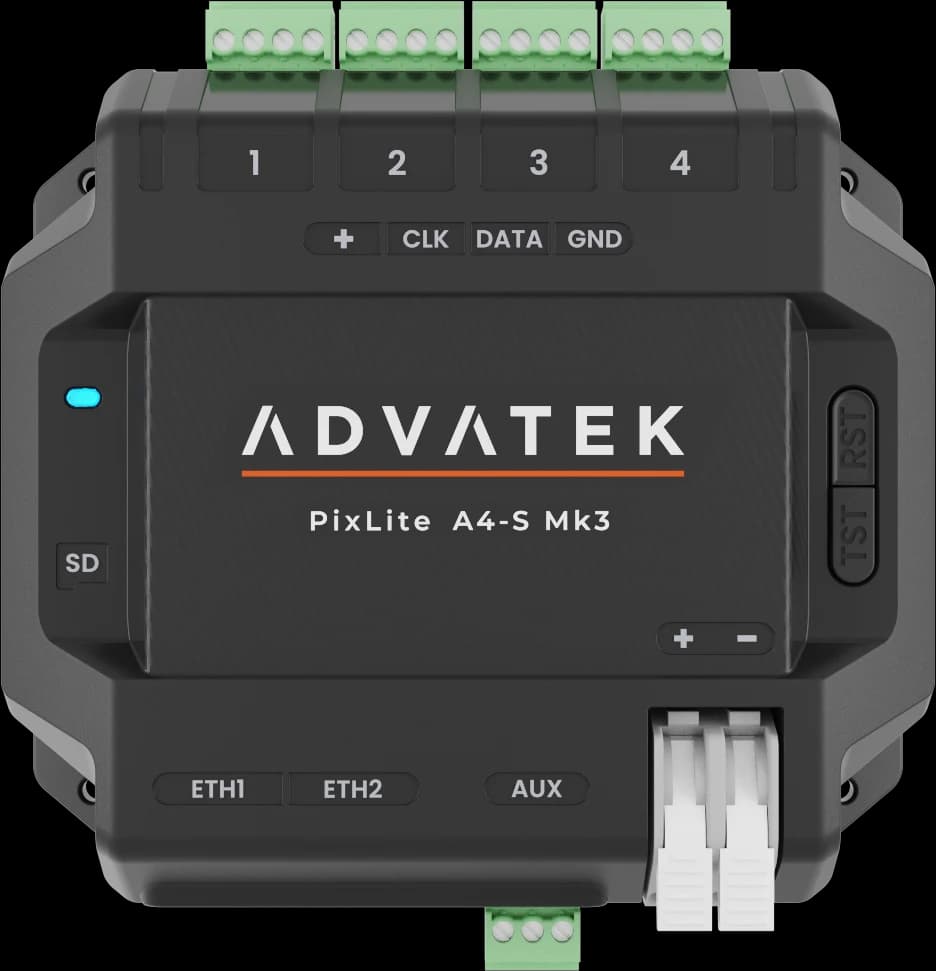
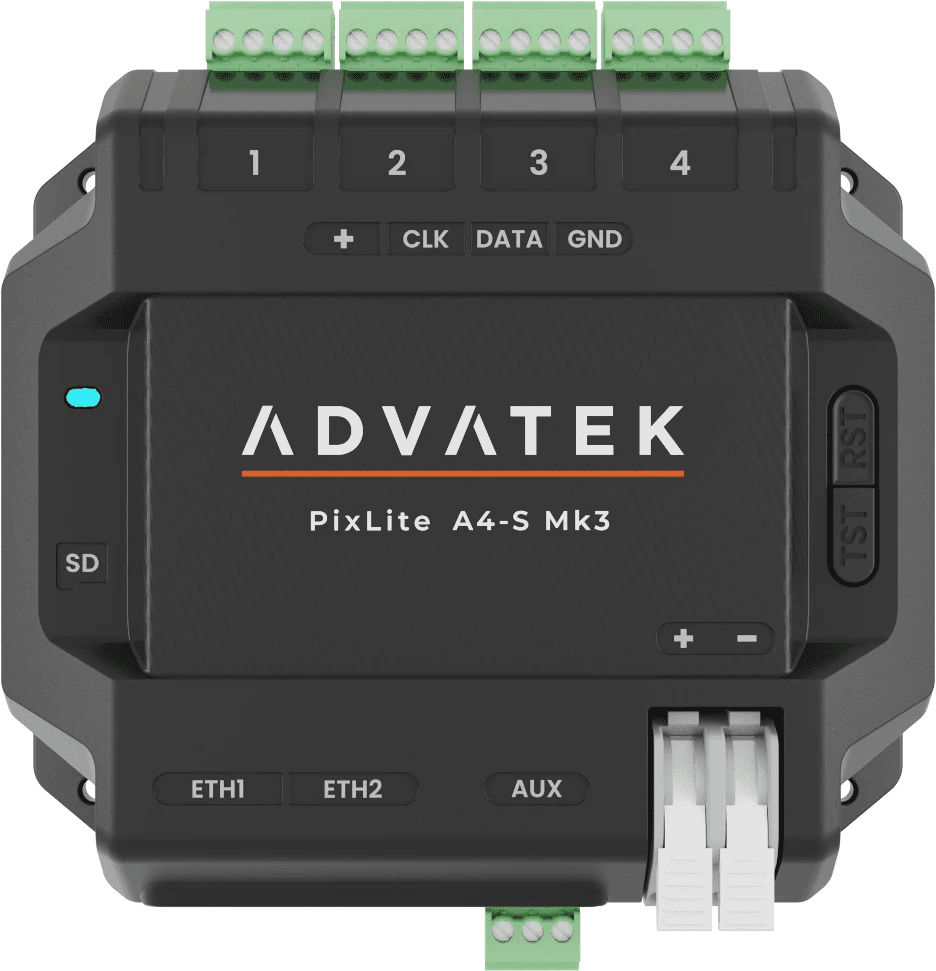
A4-S Mk3 — "The Bar & Restaurant Workhorse"
Capacity: up to 24 universes (~3,840 RGB pixels). This is the sweet spot for mid-size F&B venues: premium bars, 200-400 m² restaurants, boutique lounges. It comfortably handles:
- Counter glow + back-bar pixel + accent (full bar rig)
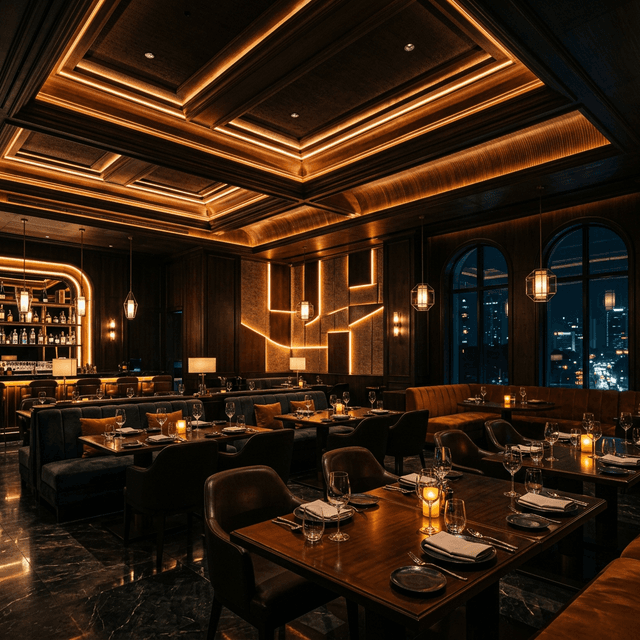
- Cove ceiling for a 200 m² restaurant + accent feature wall
- Small multi-room KTV (4-6 rooms)
Why we often pick A4-S Mk3 for F&B: small footprint, flexible mounting, and electrical fault protection — important in venues where the power cabling isn't always ideal.
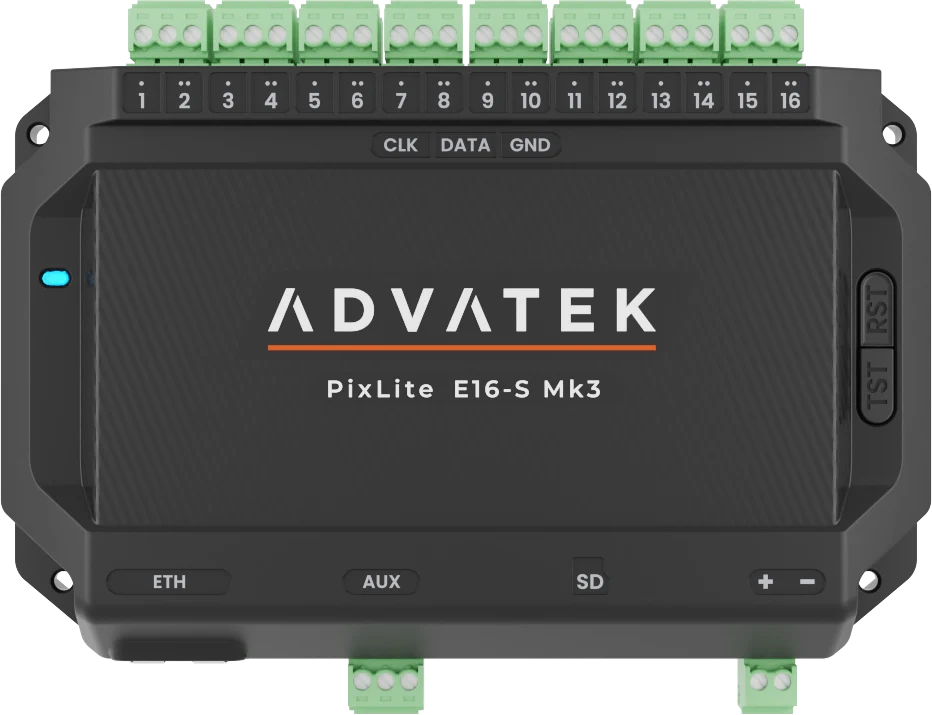
E16-S Mk3 — "The Large-Scale Champion"
Capacity: up to 96 universes (~15,360 RGB pixels). This is the controller for enterprise-scale projects: large clubs, concert venues, multi-floor commercial spaces, large temporary events. Typical scenarios:
- Nightclub / venue 600 m² with ceiling pixel mapping + side wash
- Event lighting: pixel-mapped large stage panels
- Multi-room KTV/karaoke with 20+ rooms and per-room scenes
- Stadium-scale facade with pixel mapping
E16-S Mk3 has the best output-per-cost ratio in the series. For projects where you need a lot of universes per controller (fewer units to manage), it's our default pick.

T8-S Mk3 — "The Long-Distance Specialist"
Capacity: up to 48 universes, with data transmission up to 300 meters. This is the specialist controller: outdoor projects, tall buildings, open spaces where the data run from the controller is far. Typical scenarios:
- Building facades with rooftop pixel rigs
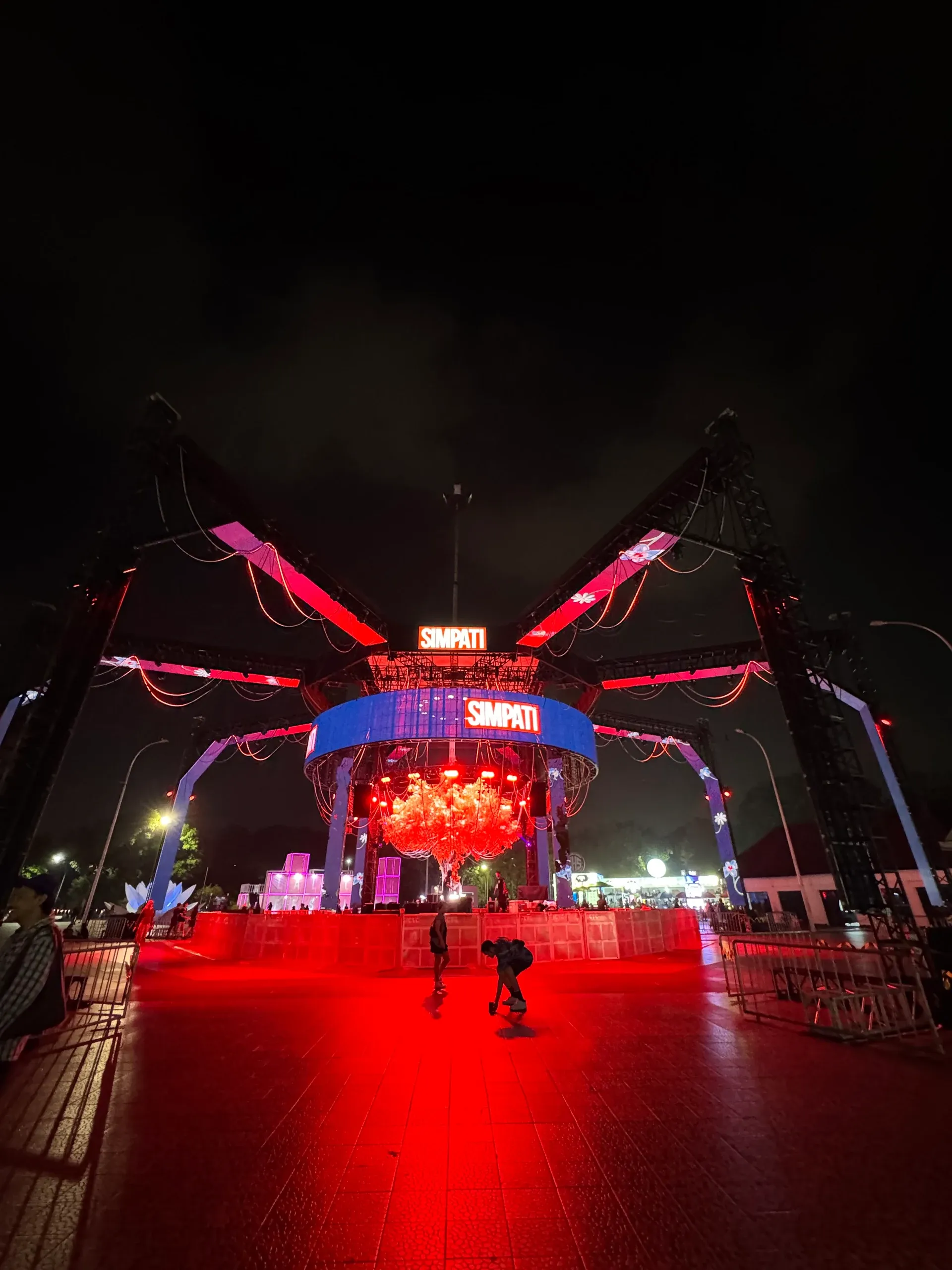
- Outdoor concerts with a stage tower far from the console
- Building-scale lighting where the controller sits in the basement and the pixels are on the roof
- Distributed lighting across a campus or resort
The key advantage: without T8-S Mk3, a 300 m data run usually requires a fiber converter or a signal repeater — extra cost and an extra failure point. T8-S simplifies that.
How to Choose: Three Questions
We usually walk clients through three simple questions:
1. How many total RGB pixels in the project?
- < 4,000 pixels → A4-S Mk3 is fine
- 4,000 – 15,000 pixels → E16-S Mk3 or one T8-S Mk3
- > 15,000 pixels → multi-unit E16-S Mk3 with synchronization
2. What's the longest distance from controller to the farthest pixel?
- < 50 m → any of the three works
- 50 – 150 m → typically you need a signal booster on A4-S/E16-S, or just use T8-S
- > 150 m → T8-S Mk3 is almost mandatory
3. Indoor or outdoor?
- Stable indoor → A4-S or E16-S
- Outdoor / climate stress → IP-rated enclosure + ground-loop isolation, paired with T8-S Mk3 for maximum reliability
Why Authorized Dealer Matters
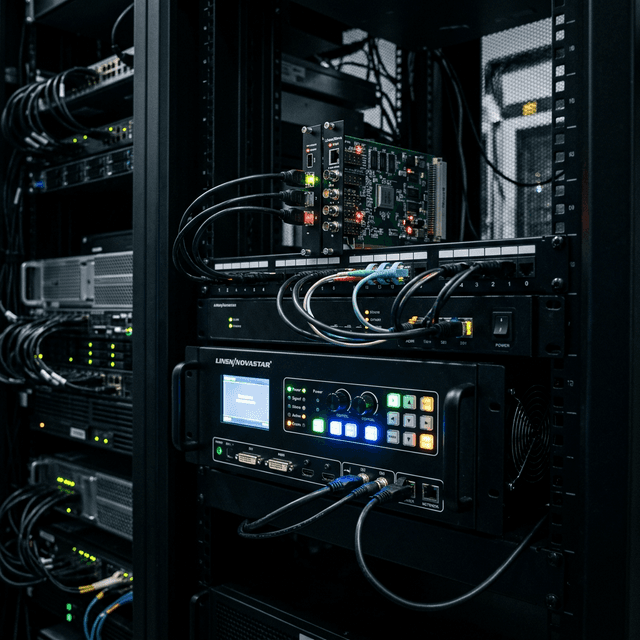
The market has plenty of "PixLite-lookalikes" with local OEM labels. The structural differences usually don't show up at install — they show up later:
Firmware updates: Advatek ships firmware that fixes edge cases (e.g., specific IC timing, sACN multicast packet handling). Cloned OEMs don't have access to this and never update.
Hardware quality control: ESD protection components, electrolytic capacitor grade, and PCB tracing on genuine units differ from clones. The consequences show in year 2 or 3 — when cloned units start failing in tropical heat.
Technical support: If you hit an edge case (e.g., a specific refresh rate that flickers on CCTV cameras), you can email Advatek through the dealer. With OEM, you're alone.
Warranty: Real 2-3 year warranty from Advatek vs. no claimable warranty on OEM units.
As Indonesia's authorized dealer, Linevolt guarantees the units we install are genuine, with up-to-date firmware, and direct technical support if you ever need it.
Wrap-up
Picking the controller isn't the most glamorous decision in a lighting project — but it's often the most consequential for the project's lifespan. The three questions above, answered up front, usually point to the right unit on day one. Everything else — install, programming, scene library — gets built on top of that foundation.
Need Help?
Consult Your Lighting Project
Our expert team is ready to help from planning to installation. Free, no commitment.