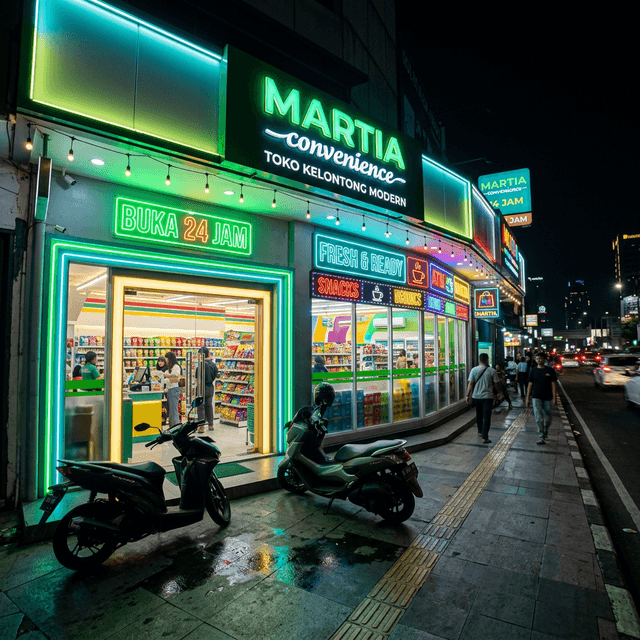
Camera-Safe Retail Lighting: Lessons from Helen's Night Mart Malang
Retail lighting that flickers on CCTV is an operations problem, not an aesthetics problem. How Linevolt designed the Helen's Night Mart Malang facade to stay safe for 24/7 cameras.
A Problem You Can't See by Eye
In most retail LED audits we run, we see one consistent pattern: lighting that looks perfect to the human eye, but is broken on CCTV. Specifically, low refresh rate LED strip causes black bands or color flicker on the rolling-shutter sensors used in almost every modern CCTV.
To the eye, none of this is visible. To the camera, it looks like an electrical glitch — or worse, like a malfunction the security operator has to log.
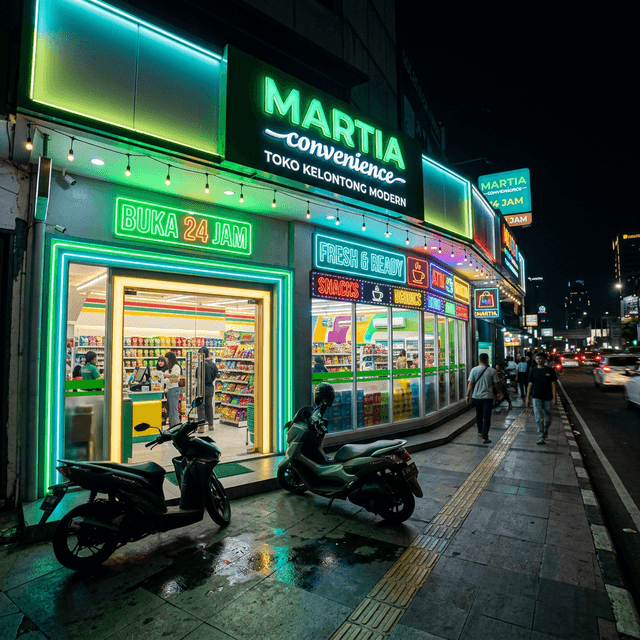
For Helen's Night Mart Malang — a 24-hour retail night-mart — this isn't an aesthetics issue. It's a security audit issue: if the CCTV footage isn't clean, incident investigation is harder, and shrink documentation is less reliable.
Why LED Flickers on Camera
This is a technical issue often missed by non-specialists. Every LED — addressable or not — actually flickers fast. Our eyes can't see it because human flicker fusion sits around 60 Hz. But CCTV cameras sample each row of pixels at slightly different times (rolling shutter). When the strip's flicker frequency interferes with the rolling-shutter timing, the result is:
- Horizontal black bands in the footage
- Color bands moving through the frame
- Color "breathing" at periodic intervals
LED strip refresh rate is usually determined by:
- The IC chip — WS2812B vs SK6812 vs WS2815 each have different characteristics
- Controller refresh rate setting — a good controller can be tuned
- PSU driver quality — cheap PSUs have high AC ripple
Hybrid Strategy: 5V for Color, 12V for Long Runs
At Helen's Night Mart we combined two strip types:
WS2812B 5V for close-range signage (storefront, main signage). The reasoning: 5V has higher color accuracy in full-color conditions, and short runs (<5 m) won't suffer voltage drop.
WS2815 12V for the long facade running tens of meters. The reasoning: 12V cuts current draw significantly, the dual-data-line gives redundancy, and long runs stay stable without aggressive power injection.
This combination reduces total power cabling, eliminates failure points, and — most importantly — lets us tune refresh rate per segment independently.
Tuning for Camera-Safe Operation
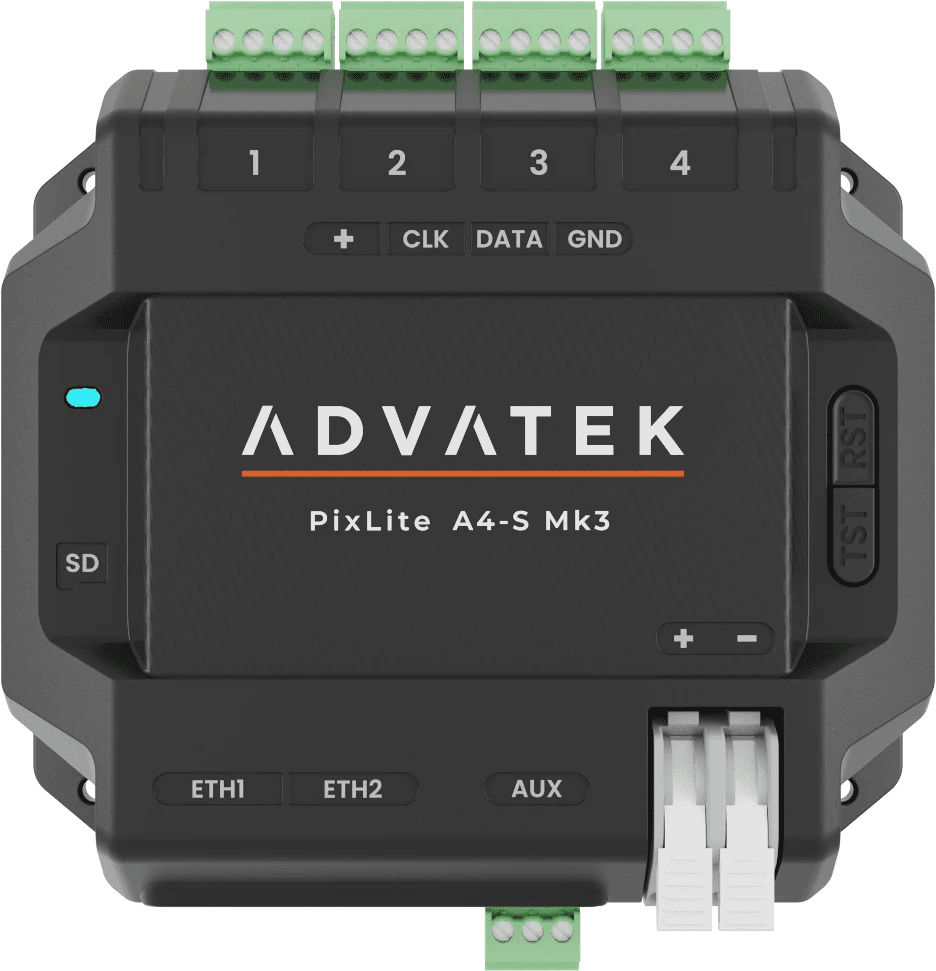
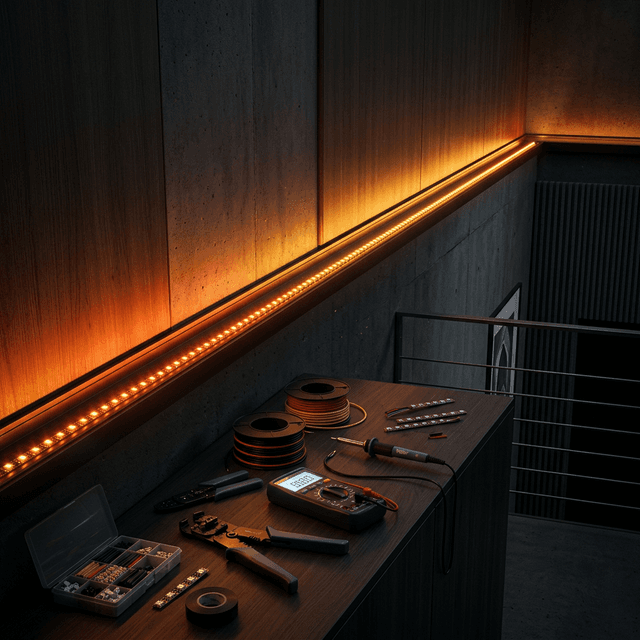
The key is in the controller settings. For Advatek PixLite Mk3, we do a few things:
1. Set refresh rate to a multiple of 60 Hz. Most CCTV runs at 30 or 60 fps. Setting strip refresh to 60 Hz, 120 Hz, or 240 Hz removes the beat frequency that causes flicker. Bad settings: 50 Hz, 75 Hz — these show up as moving bands.
2. Sync multiple strips via timecode. If two strips with different refresh rates overlap in the camera frame, you get double bands. We sync everything through the Advatek master clock.
3. Filter PSU AC ripple. Cheap switching PSUs leak 100/120 Hz ripple into the DC output. We use industrial-grade PSU with < 100 mV ripple — this costs 30% more than commercial standard PSU, but it solves a lot of downstream problems.
4. Test with a real camera before sign-off. Phone-camera tests aren't enough. We test with the actual CCTV the client will run, at the actual frame rate. If flicker shows up, we tune the controller — we don't blame the camera.
Tropical-Tough: Material Details
Helen's Night Mart is partial outdoor — part of the facade catches direct rain and UV. The materials we used:
- UV-grade aluminium profile: standard plastic profiles yellow within 6 months; aluminium with UV-rated plastic cover lasts 5+ years
- Opal diffuser, not clear: clear diffusers show hot spots at every pixel; opal scatters evenly
- IP65 on junction boxes: every connection point is IP65-rated with rubber gasket
- Dual-feed power injection every 5 m: rain and humidity can introduce resistance at connections; dual-feed maintains voltage across the run
Operational Lessons
From the Helen's project, three recommendations we share with other retail owners:
1. Audit CCTV footage from day one. Don't wait for an incident. After installation, capture 30 seconds of footage in several scenarios (day, night, rain). If there's flicker, address it while the install team is still on site.
2. Document the controller settings. Once camera-safe tuning is done, save the controller config file somewhere safe. If the controller is replaced (say, year 3), the config can be restored without re-testing.
3. Refresh rate is an operational parameter, not an installer parameter. Many installers set the refresh rate to default and leave. For 24/7 venues with CCTV, this is a parameter that needs to be tuned with the client's actual camera.
Wrap-up
Good retail lighting is lighting that doesn't become a reason for support calls. Camera-safe isn't a premium feature — it's the minimum standard for a 24/7 commercial venue. And tuning for camera-safe operation isn't complex; it just needs a controller that can be tuned and an installer who knows what to tune.
Need Help?
Consult Your Lighting Project
Our expert team is ready to help from planning to installation. Free, no commitment.