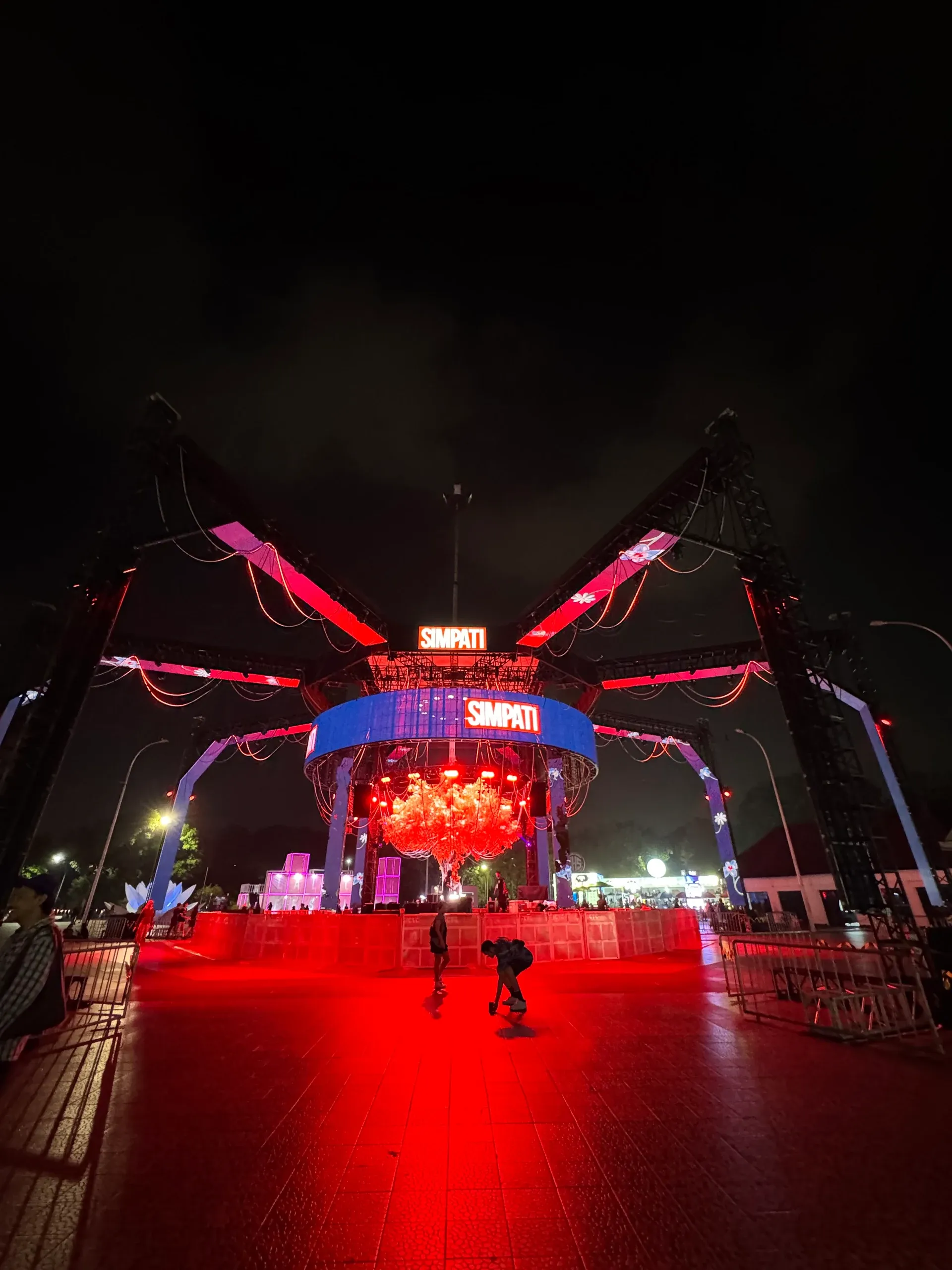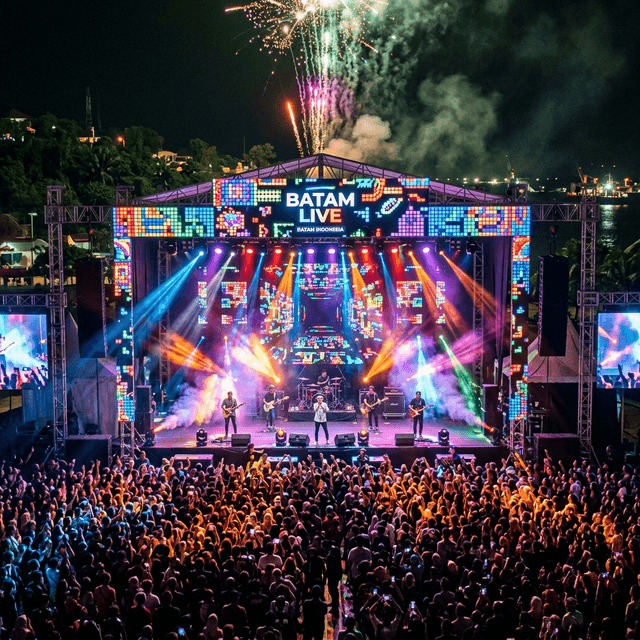
The Anatomy of Stage Pixel Mapping: A Look Inside Tembak Langit Batam
Pixel mapping that works live for bands and DJs takes more than just a lot of strip. A technical look inside the Tembak Langit Batam stage system — from the console to the farthest pixel.
What "Pixel Mapping" Actually Is
"Pixel mapping" is a phrase you hear a lot, but it's rarely explained structurally. Simply put: pixel mapping treats an arrangement of LED pixels as an "irregular display" — on a ceiling, on panels, on the floor, or all of the above — then maps video or animation content onto that geometry so each pixel shows one point of the picture.
This is different from traditional lighting where one fixture equals one "big color". In pixel mapping, thousands of pixels each carry their own color, and the whole thing reads as one piece of motion to the eye.
For Tembak Langit Batam — a hybrid venue that has to serve both live band (intimate, organic) and DJ sets (high-energy, programmable) — pixel mapping isn't a luxury; it's the only way to transition smoothly between modes.
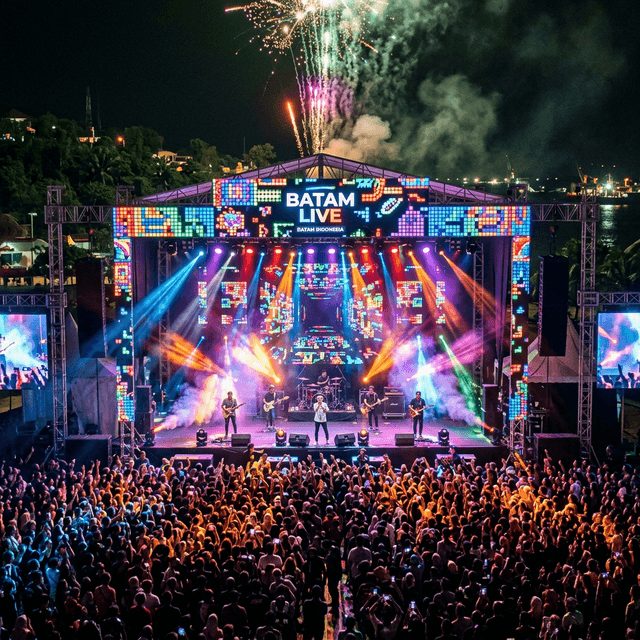
System Components: Five Layers
A reliable live-stage pixel mapping system is built from five layers. When one layer is wrong, the whole system becomes fragile.
Layer 1 — Pixel & Strip
The strip choice drives a lot of downstream decisions. For stage we almost always pick WS2815:
- 12V — lower current draw on long runs
- Dual-data-line — if one data pin fails mid-show, the strip stays alive to end-of-line
- Consistent refresh rate — important when captured by live cameras
5V WS2812B still has its place in static F&B work, but for live shows: WS2815.
Layer 2 — Power Distribution
A stage project usually has 100+ meters of strip. At 12V the per-meter current is still significant. We use:
- Power injection every 5 m, dual-feed (cable in from both sides)
- Industrial-grade PSU with 30% margin above peak draw
- Local PSU distribution, not one giant central PSU — shorter DC runs
- Wire gauge matched to current: AWG 14 for 10A, AWG 12 for 15A
Many projects fail because of savings on power cabling. The result that shows up: colors collapsing to red-brown at the end of the run, and the last pixels flickering when all channels go full power (full white).
Layer 3 — Data Distribution
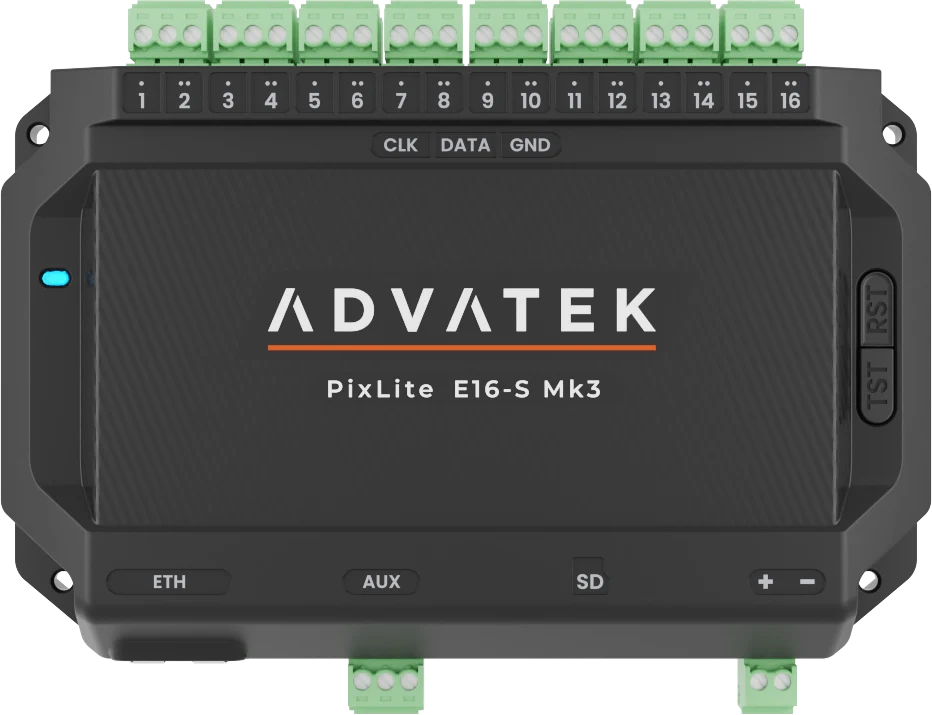
This is the heart of the system. The controller choice sets the total pixel capacity (universes), refresh quality, and reliability.
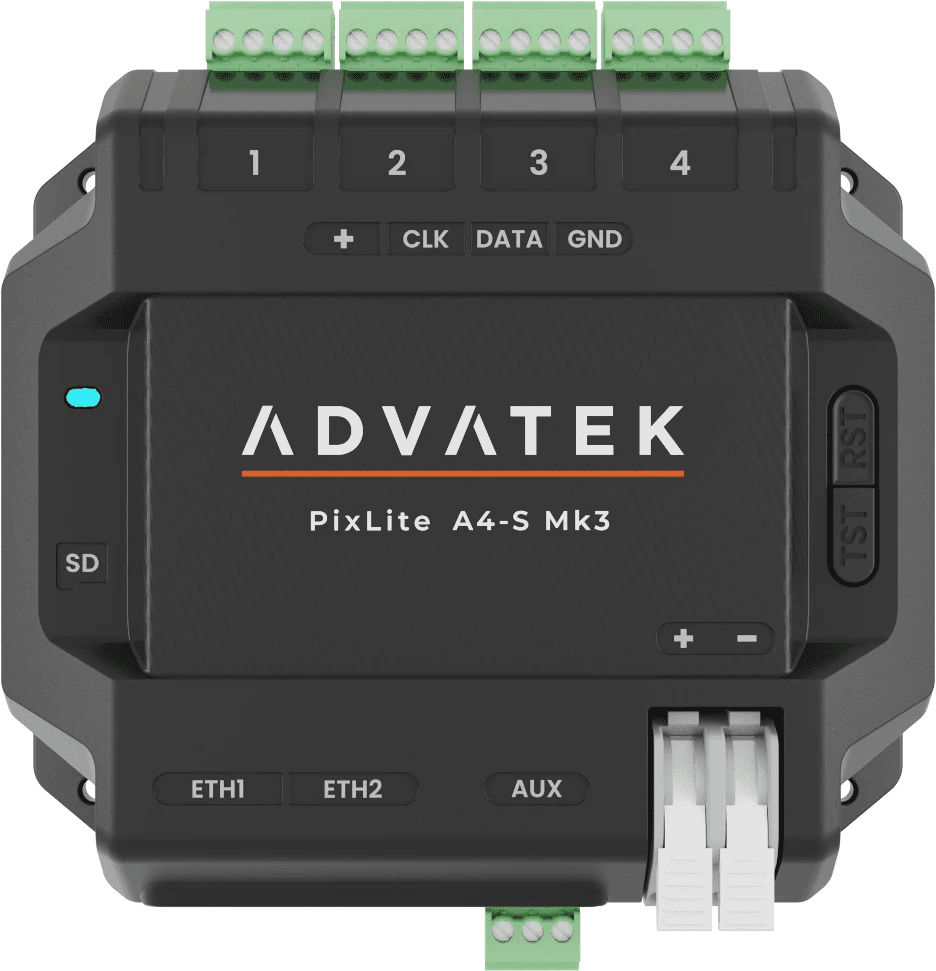
For Tembak Langit we used the Advatek PixLite E16-S Mk3 — 96 universes (~15,360 RGB pixels), 16 output ports, electrical fault protection, and an active firmware roadmap. Data distribution:
- Master controller in the central rack
- Cat6 runs to break-out boxes at each stage zone
- Break-out box converts to strip data line
- Longest run < 50 m (under the standard limit for max reliability)
Layer 4 — Software Stack
Two pieces of software run in parallel:
MADRIX Professional as the pixel-content engine. Its job: render animations, scene effects, and sound-reactive logic into sACN/Art-Net output the Advatek controller understands.
Resolume Avenue as the video-content engine. For traditional video content (logos, motion graphics, IMAG from cameras), Resolume triggers MADRIX through OSC or timecode.
Why two pieces of software, not one? Each has its own strengths:
- MADRIX: native pixel-mapping, sound input, effect generator
- Resolume: video composition, IMAG handling, deck-style live mixing
The combination lets the live operator mix video + pixel content without having to pre-bake everything.
Layer 5 — Console & Operator
None of the above matters if the operator can't trigger scenes fast enough during a show. Our usual console layout:
- MIDI controller as physical input for MADRIX scene triggers
- APC40 or iPad TouchOSC as a backup channel
- Time-code link to the audio console (DJ track timestamp)
- Physical cue sheet for band setlists (scene-per-song order)
For DJ sets, sound input automation + manual scene rotation is enough. For live bands, a rehearsed per-song cue sheet is more reliable than automation.
Reliability Under Show Conditions

A live show is a high-stakes environment: no room for failure. Three layers of backup we always run:
1. Hot-swap spare controller. We always carry an identical spare — if the master controller hangs, swap is < 30 seconds.
2. Redundant power. The controller and critical PSUs run on a separate UPS. A brief power dip doesn't take the show down.
3. Fallback content. If the data network has issues, the controller has built-in scene presets that auto-play. Not a blackout — generic-but-presentable fallback.
For venues with > 200 m data runs (e.g., outdoor concerts, tall buildings), we usually use the Advatek T8-S Mk3, which natively transmits data up to 300 meters — removing the fiber-converter as a failure point.
Lessons from Tembak Langit
Three insights from this setup that apply to similar venues:
1. Plan the rig for two show modes, not one. A venue that serves both band and DJ has very different visual needs. The strip rig has to be designed so the scene library supports both without physical re-rigging.
2. Invest in legitimate software licenses. MADRIX Professional isn't cheap, but cracked versions are often unstable under high load (full venue, complex content). For commercial venues, a proper license is a valid operational cost.
3. Train the local operator — don't make them dependent. After commissioning we train venue staff for 2-3 days. The goal: small issues (a missing preset, a muted channel) shouldn't require an external tech.
Wrap-up
Live-stage pixel mapping is engineering work. The visual glamour shows up at showtime, but what makes it consistent night-to-night is the decision-making done 2-3 months before — strip selection, power distribution, software stack, operator training. That's the lens we hold whenever we onboard a new stage venue.
Need Help?
Consult Your Lighting Project
Our expert team is ready to help from planning to installation. Free, no commitment.